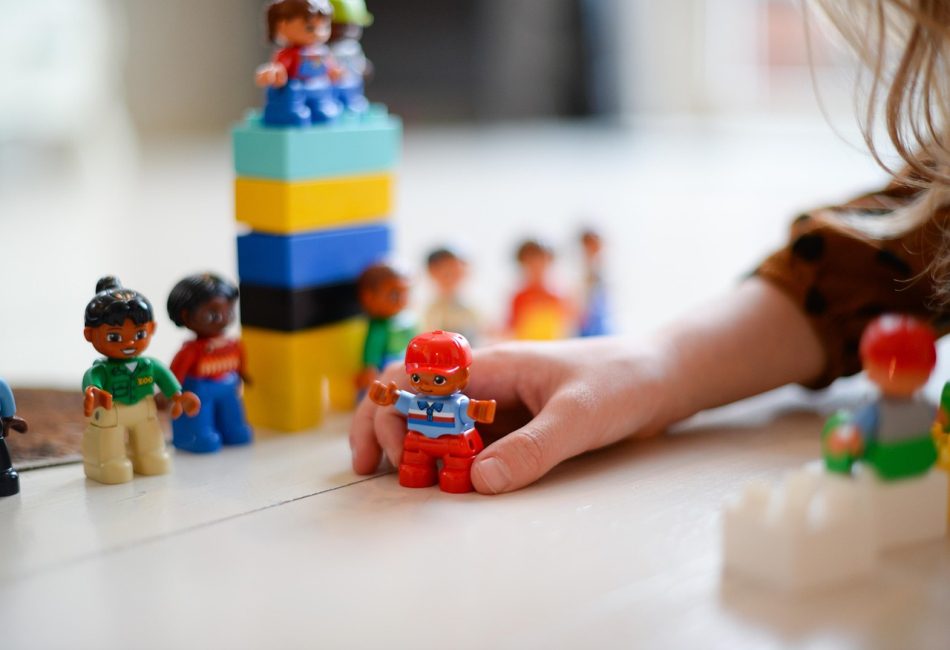
Children engage with toys in ways that shape how they think and interact with the world. Each type of play introduces different ways of understanding their surroundings. For example, building blocks encourage problem-solving and spatial reasoning, while role-playing toys help develop communication and social skills.
These activities also introduce concepts like cause and effect, cooperation, and creativity. The way children experiment with toys shapes their approach to learning, relationships, and challenges. Over time, these early experiences can play a role in developing skills that may influence their future careers.
Let’s take a look at some examples of how toys can influence skill development and career interests.
Scalextric and Toy Vehicles
Slot car racing sets like scalextric and other toy vehicles can childrens’ enhance coordination, reaction time, and decision-making. When controlling a small racing car on a track, they must adjust speed, handle turns, and react quickly to obstacles. These actions train their hands and eyes to work together smoothly, which improves their ability to perform precise movements.
Quick reflexes and split-second decision-making are essential during these activities as well. Children must decide when to speed up, slow down, or change direction to avoid crashing or losing control. This process helps them understand cause-and-effect relationships, teaching them how small adjustments impact performance.
These skills are helpful in many real-world activities. For instance, strong coordination and reaction time are crucial in sports, driving, and even technical fields like aviation and robotics. Similarly, decision-making skills developed through racing games also apply to problem-solving in professional settings, where fast thinking and strategic planning are valuable.
Building Blocks and Construction Sets
Stacking blocks, assembling structures, and designing layouts encourage children to think step by step and plan their actions carefully. Educational experience toys like these provide hands-on learning that enhances problem-solving skills and logical thinking. When building a tower or a complex structure, they must decide where each piece should go to maintain balance and stability. If the structure collapses, they need to analyse what went wrong and adjust their approach. This improves logical thinking and problem-solving skills.
These activities teach children how different shapes and sizes interact as well. They begin to understand that a wide base provides more stability than a narrow one and that taller structures need stronger foundations. Experimenting with different configurations helps them see patterns and develop spatial awareness, which is essential for tasks requiring careful planning and organisation.
Children who enjoy building activities can explore careers in architecture, engineering, and design, where problem-solving and spatial awareness are essential. Even fields like interior design and game development benefit from strong spatial reasoning, as they require planning, structure, and the ability to visualise how different elements fit together.
Dolls and Role-Playing Sets
Acting out real-life scenarios with dolls and role-playing sets helps children understand emotions, relationships, and social interactions. They strengthen their ability to interpret and communicate emotions through imaginative storytelling, role assignment, and perspective-taking. Playing as a doctor, teacher, or caregiver allows them to step into someone else’s shoes, strengthening their ability to empathise with others.
Besides emotional intelligence, this type of play also improves communication skills. Children learn to express thoughts clearly, listen to others, and respond appropriately in different situations. Whether comforting a toy that is “hurt” or negotiating a role in a pretend game, they develop the ability to handle emotions and interact effectively.
Emotional intelligence and communication skills are essential in many careers that involve human interaction and problem-solving. These include teaching, healthcare professions (such as nursing, therapy, and counselling), customer service and hospitality, human resources, public relations, law and mediation, sales and marketing, and leadership and management. Each of these fields requires understanding emotions, navigating relationships, and communicating effectively to solve problems and support others.
Puzzle Games and Brain Teasers
Like building blocks and construction sets, solving puzzles and engaging with brain teasers help children sharpen their ability to think critically and logically. Matching pieces, recognising patterns, and identifying solutions encourage them to analyse problems step by step. These activities train their minds to approach challenges methodically, which improves their reasoning and decision-making skills.
Working through puzzles also strengthens patience and perseverance. Some challenges require multiple attempts before finding the right solution, teaching children the importance of persistence. The process of trial and error helps them build resilience as they learn that making mistakes is part of problem-solving.
Many careers benefit from the skills developed through puzzle play. In addition to engineering, aviation, and game design, finance, cybersecurity, artificial intelligence and data science, law and forensic science, research and development, and urban planning all require problem-solving, logical thinking, and analytical skills. These fields demand the ability to assess patterns, interpret data, and develop practical solutions to complex challenges.
Arts and Craft Kits
Expressing creativity through painting, drawing, and crafting introduces children to colour theory, design principles, and fine motor control. Exploring different materials and techniques also allows them to experiment with new ideas and develop artistic confidence.
Fine motor control improves as they use pencils, brushes, and scissors to create detailed work. Holding and manipulating these tools strengthens hand-eye coordination and precision. The ability to control small movements is valuable not only in artistic expression but also in daily tasks and professions that require dexterity, such as surgery, jewellery making, and technical drafting.
Graphic design, fashion, and media production often attract individuals with a background in creative expression. Designers blend artistic vision with technical skills, fashion professionals rely on an eye for detail, and media producers use creativity to develop engaging content.
Final Thoughts
Toys influence skill development in ways that extend beyond childhood. While they do not determine a child’s future, they help shape strengths and preferences that may guide career interests.